When Threads of Heritage Become Contemporary Art
Nzinga Threads is the multidisciplinary conceptual practice of Sandra Martins, shaped by identity, experience and heritage.
-
Personal experience often becomes a point of departure for wider questions about how identity is inherited, constructed, perceived and negotiated. The “threads” are both tangible and conceptual, connecting individual experience to ancestry, social structures and the possibility of becoming.
Moving between vulnerability and resistance, the work asks what it means to belong without disappearing into the whole, to occupy space without seeking permission, and to transform without surrendering the self.
Concepts determine their form, allowing each work to develop through whatever materials, processes or disciplines best serve its meaning.
Being
35mm colour film. Nine photographic prints presented as a 3 × 3 sequence.
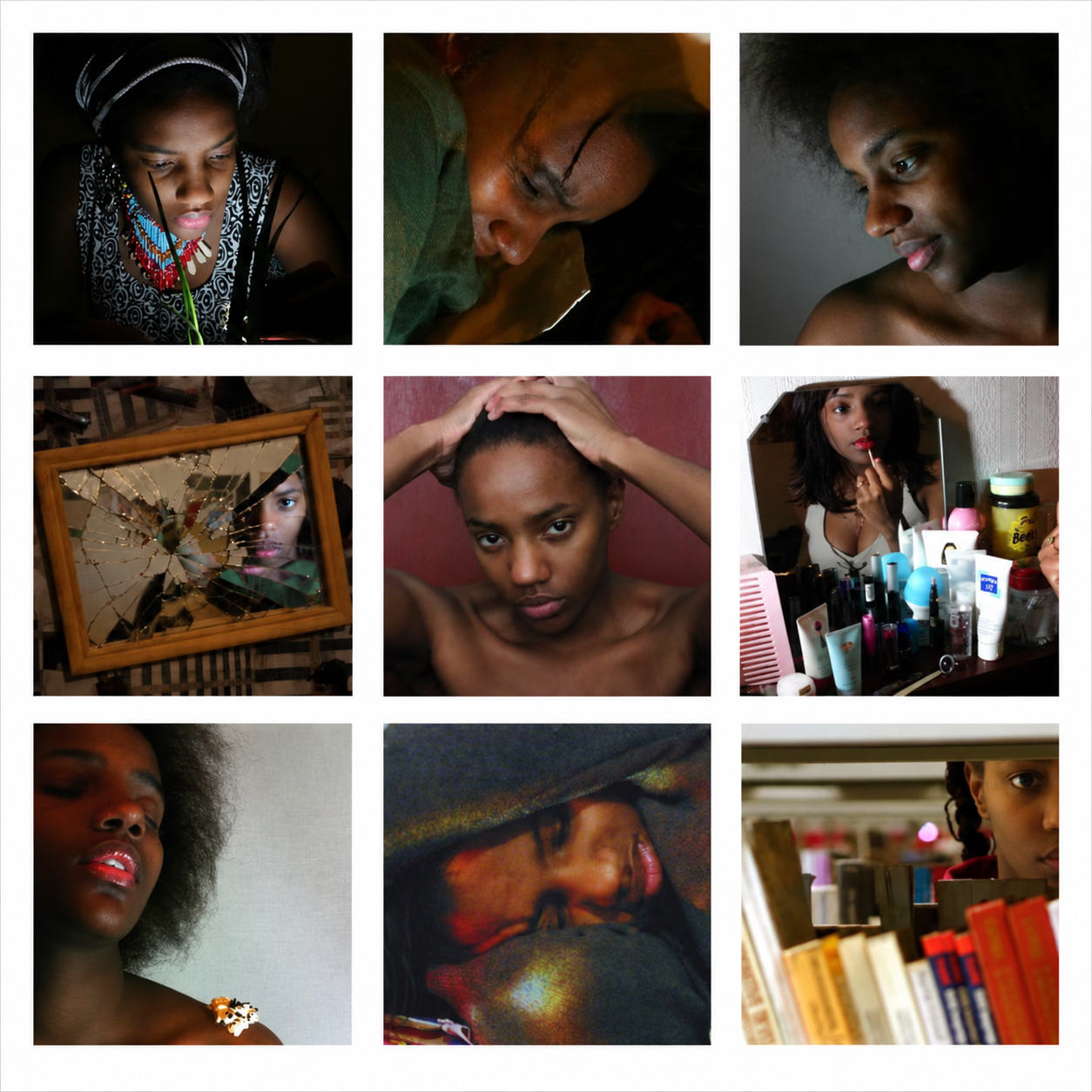
Being explores the construction of Black identity through ancestry, violence, self-perception, gender, beauty, sexuality, precarity and knowledge.
-
Each photograph carries its own narrative, but meaning also emerges through the relationships between them. The grid invites multiple readings rather than prescribing a single journey. Nature and books occupy opposite ends of one diagonal as sites of knowledge, questioning who determines what counts as knowledge and education, and ultimately what it means to be civilised. Another moves from self-regard, through the body at the centre, towards fetishisation and the body becoming something to be desired and consumed.
At the centre sits an exposed, androgynous Black body, deliberately difficult to categorise. It becomes a point of suspension within the work: the body before gender, beauty, desirability and respectability tell us how it should be seen.
Elsewhere, mirrors create another dialogue: rejection of the self is confronted by an image attempting to conform to Eurocentric ideals of beauty. Violence and precarity offer another possible trajectory through the sequence, suggesting how external conditions become entangled with the formation of the self.
Being has no single direction in which it must be read. Its meanings shift according to the path taken through the nine images, asking how Black identity is inherited, learned, disciplined, desired, rejected and constructed; how much of the self is determined from within, and how much by the world looking back.
Prête-à-criminaliser
Digital photograph.
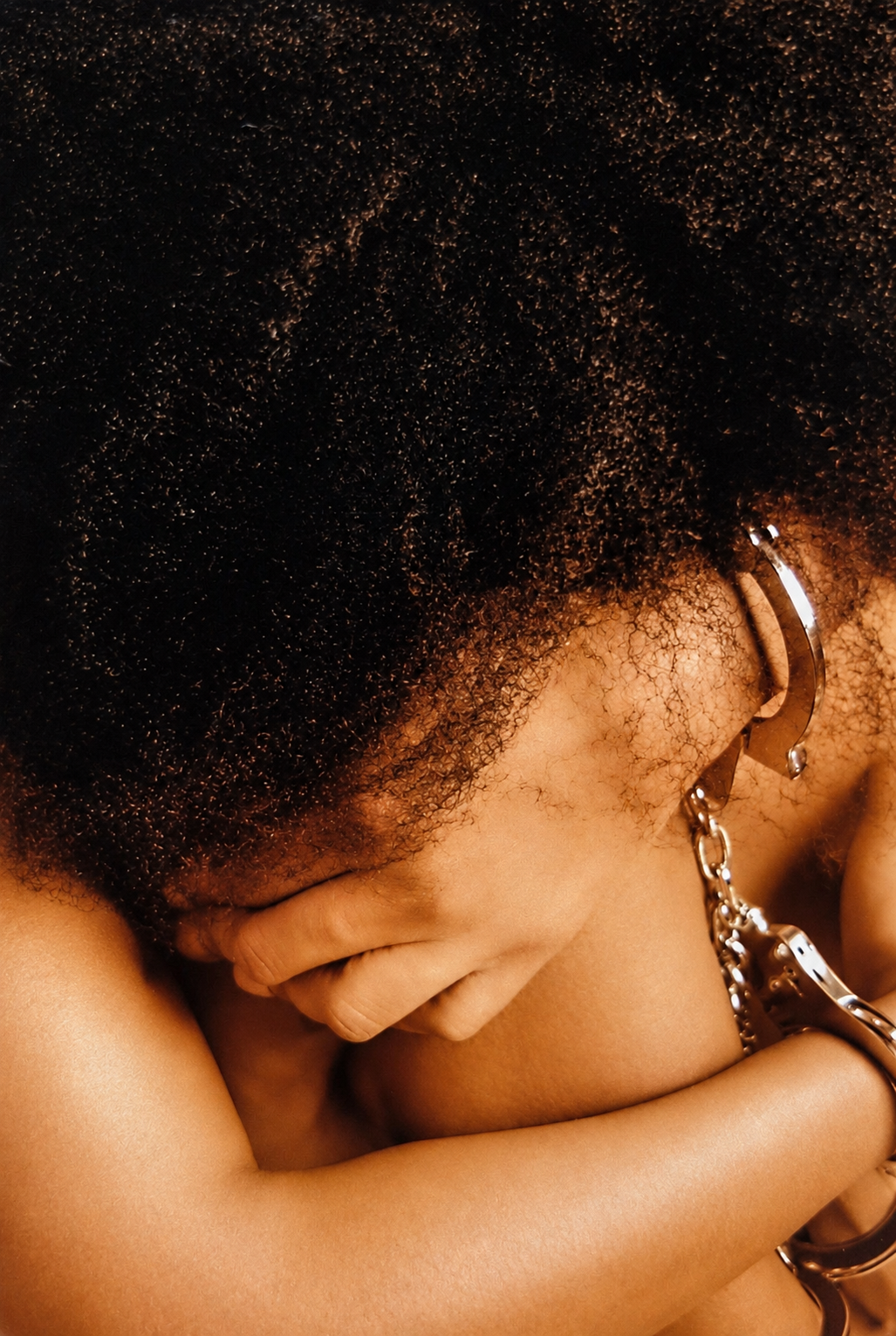
Prête-à-criminaliser explores the presumption of criminality imposed upon Black bodies, and how ordinary presence can become suspicious when viewed through a racialised gaze.
-
Prête-à-criminaliser borrows from the French expression prêt-à-porter (“ready-to-wear”), transforming it into prête-à-criminaliser (“ready to criminalise”). The title plays with how quickly a Black body can be made ready for suspicion and accusation through the gaze of others.
The photograph emerged from a lived experience on New Year's Eve in Shepherd's Bush, London. I was working as a Personal Assistant, supporting a wheelchair user with cerebral palsy to participate independently in the evening. They wanted to socialise, and my role was simply to remain nearby and available if assistance was needed.
Although Shepherd's Bush is known for its large Afro-Caribbean community, we were in a pub predominantly frequented by white people. I had found a quiet place to sit while the person I was supporting enjoyed their evening.
A white woman sitting nearby saw me put my phone in my pocket and immediately decided that I had stolen it. What disturbed me was not only the accusation, but the moral authority with which she delivered it. She spoke to me about karma and spiritual consequence, explaining why what I had supposedly done was wrong as though she were guiding me towards a more enlightened way of behaving.
She continually demanded that I unlock the phone and prove that it was mine.
I was about to comply when an image crossed my mind: I saw myself smashing the phone into her face.
I had not been experiencing myself as angry. I had not raised my voice, threatened her or become confrontational. Yet at the very moment I was being imagined as criminal, that image entered my consciousness.
Instead of acting on that invasive thought, I simply refused to comply. I had done nothing that required proving, and I did not owe her evidence of my innocence.
She then reported me to the bouncer, who came over and questioned my quiet presence. Why was I sitting alone? Why was I not behaving like everybody else? I explained that I was working, supporting a vulnerable person, and needed only to remain somewhere I could be found if assistance was required.
The news of a thief in the corner spread through the pub. By the end of the evening, several inebriated people had gathered outside supporting this woman. While I was waiting for my client so that we could leave, the situation could easily have escalated.
At that point, continuing to resist could create a confrontation in which my client would be left without assistance.
So I deliberately took my phone out and unlocked it where they could see me.
Only then did the situation de-escalate.
What began with one woman's unsupported assumption ended with the indignity of having to demonstrate my innocence to a group of strangers, a concession I made at personal cost because they represented a very real risk to my client's and my safety.
Prête-à-criminaliser considers what happens when a Black body occupies a space in which it is not permitted simply to be neutral. Sitting alone becomes behaviour to explain. Possessing a phone becomes possible theft. Refusing to prove innocence becomes suspicious in itself. Even composure does not protect the individual from being assigned a role by somebody else's perception.
The violent image is central to the work because it complicates that relationship further. I was being imagined as criminal while remaining outwardly calm, with the pressure of that accusation briefly generating within me the very violence that was absent from my conscious behaviour. I learned how profoundly another person's perception can intrude upon the self.
The work is therefore not simply about being falsely accused of stealing a phone. It is about power and permission: who is permitted to occupy a space without explanation, who is presumed innocent without having to demonstrate it, and whose ordinary presence can be transformed into evidence by the gaze of somebody already prepared to see a criminal.
Breakable
Five photographic prints presented as a horizontal sequence, approximately 2.5 m across when installed.

Breakable explores the walls that confine us: those shaped by social and systemic structures, those carried through inherited histories and those we learn to construct within ourselves. It considers what it takes to recognise these boundaries, challenge them and find a way through them.
-
Walls can protect us. They can also become the boundaries of the lives we learn to accept.
Some are visible. Others exist within social structures, institutions and expectations that influence access, opportunity and belonging. Others still are carried through inherited histories. Generational trauma can transmit patterns of fear, protection and survival, allowing the consequences of earlier conditions to remain present long after the circumstances that first produced them have changed.
Over time, the distinction between the walls around us and those within us can become difficult to locate. Repeated experiences of limitation can teach us where we are expected to stand, how much space we should occupy and what it seems reasonable to hope for. Protection can become withdrawal; withdrawal can become confinement. A boundary encountered often enough can eventually begin to feel like our own.
Breakable moves through that experience of psychological confinement towards the moment when endurance becomes resistance. The body begins to fight the wall with bare hands. There are no instructions and no tools have been provided. The hands scratch, test and persist, finding weakness in something that had appeared solid. Resourcefulness lies not in already possessing the means of escape, but in creating a way through when none has been given.
Breaking the wall is not the end of the struggle. Beyond the rupture there is no effortless passage into freedom. The fragments remain underfoot. The same material that formed the barrier must now be crossed, making the journey through difficult, uncertain and sometimes painful. Survival is not simply reaching whatever lies on the other side; it is finding the courage and means to cross the remains of what once contained us.
Breakable considers the relationship between vulnerability, inherited experience, psychological confinement and agency. Some barriers must be challenged in the world around us; others have to be recognised within ourselves. Breaking through becomes both resistance and reconstruction: questioning the limits we have inherited or learned, creating tools where none were offered, and continuing across difficult terrain towards the possibility of something different.
It Takes a Village… to Flourish
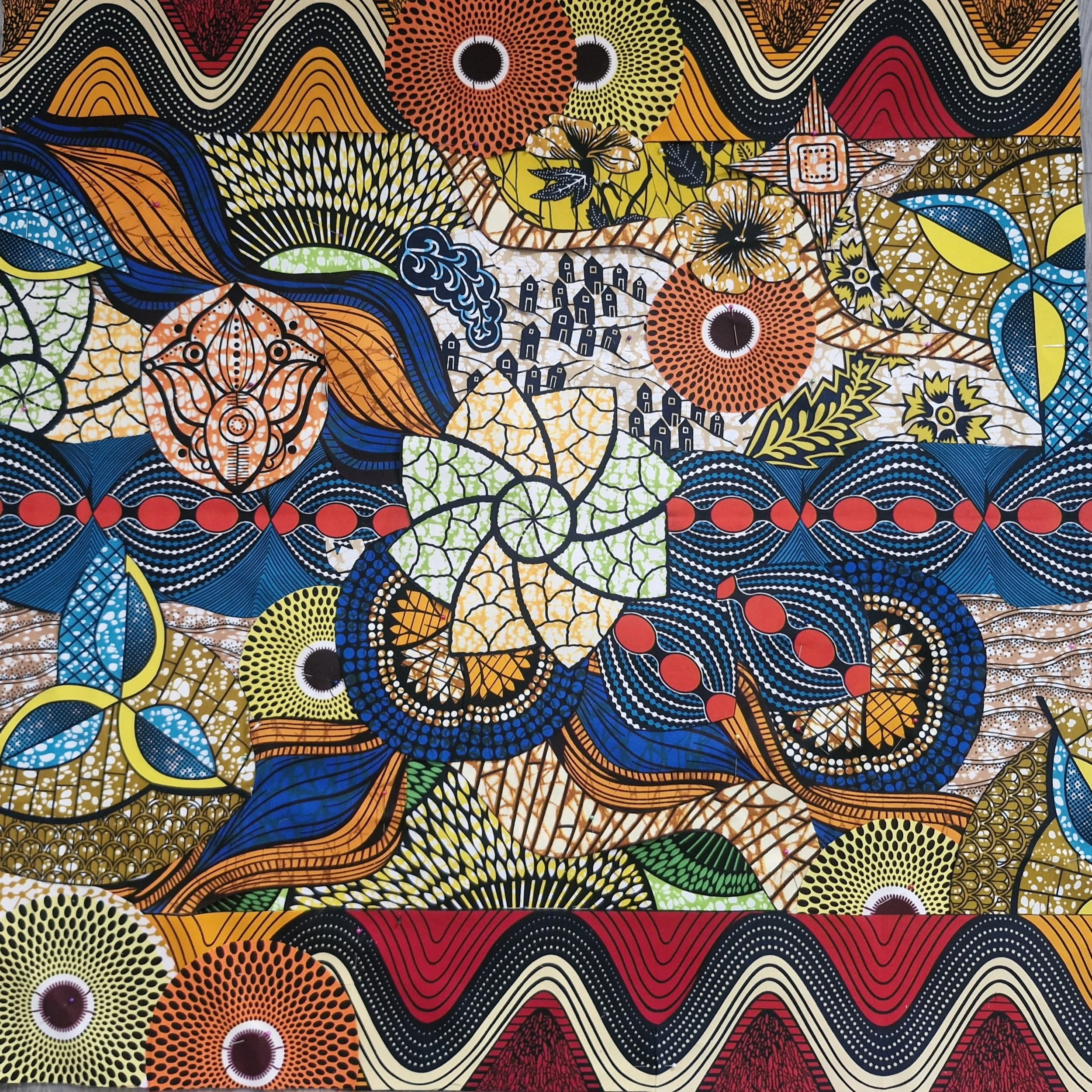
Textile tapestry. African-print fabrics, cut and assembled by hand. Approximately 1 × 1 m.
It Takes a Village… to Flourish considers the difference between surviving and flourishing, and the relationships, resources and conditions that allow us to move from one towards the other.
-
There is a difference between surviving and flourishing. The title reworks the familiar saying “It takes a village to raise a child”, extending its meaning beyond childhood and towards fulfilment. Survival can demand that our energy is directed towards getting through what is immediately in front of us. Flourishing asks what becomes possible when life is no longer defined by struggle alone: connection, opportunity, curiosity, creativity, participation and growth.
It Takes a Village… to Flourish emerged from a desire to move beyond survival as a way of being. It considers community not simply as a source of support in moments of difficulty, but as something that can enlarge possibility. Through other people we encounter different ideas, experiences and ways of being, extending what might otherwise remain within the limits of our own world.
The construction of the tapestry reflects this process. The fabrics are not accepted as they were found. They are cut apart, selected and recomposed, preserving particular forms, colours and details while leaving others behind. Individual fragments retain their identities, yet their relationships change as they become part of something new.
In this sense, the work treats experience in much the same way. To flourish is not to absorb everything we encounter. Some experiences nourish us, others constrain us, and even difficult encounters may leave something that can be understood, transformed or used differently. Growth involves discernment: recognising what sustains us, what needs to be rejected, and what can be remade into something that did not exist before.
The work also recognises that the conditions for flourishing are not equally available. Time, security, resources and supportive relationships can create space for imagination and growth, while their absence can make survival itself consume much of a person's energy. Flourishing is therefore neither entirely individual nor entirely communal. It emerges through an exchange between what the world offers us and what we are able to make from it.
The village is not simply the place that catches us when we fall. It is also material from which we construct what comes next. Belonging does not require accepting the whole unchanged. Like the tapestry, it can involve choosing, refusing, transforming and preserving what nourish us, creating the conditions in which something new can flourish.
Sovereign
Wearable textile assemblage incorporating mixed fabrics, threads, beads and cowrie shells.
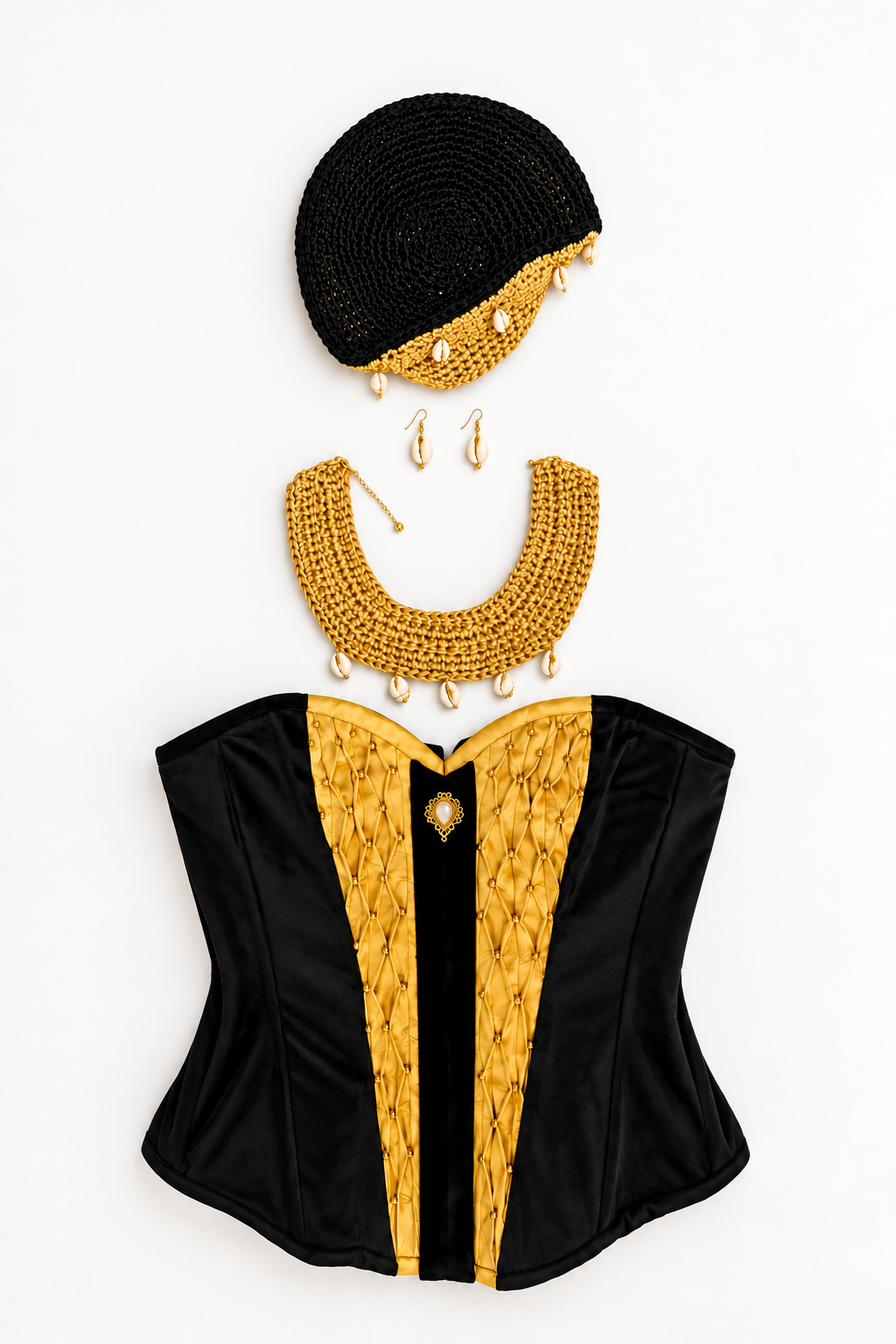
Sovereign explores self-determination and the authority to define oneself, bringing power and vulnerability, survival and creativity, resilience and femininity together as expressions of an identity claimed on its own terms.
-
Sovereignty does not require the absence of vulnerability. It is the ability to inhabit vulnerability and power, survival and creativity, resilience and femininity without allowing one to cancel out the other.
Sovereign brings together individually made wearable pieces to construct a language of self-determination. The hat sits somewhere between a crown and military headwear, while the corset, traditionally associated with shaping and constraining the female body, takes on the character of armour. Threads, fabric, cowrie shells and beads bring softness, labour and adornment into forms that also suggest protection, authority and resistance.
These apparent contradictions are deliberate. Armour speaks to the need to survive, but survival is not the destination. Creativity transforms what protects the body into something through which the self can also be expressed. Femininity does not diminish resilience, just as vulnerability does not negate power. Strength does not have to be constructed through the rejection of softness.
The individual elements can exist independently, yet when brought together they begin to suggest a figure. A hat becomes a crown, jewellery marks the space of a face and neck, and the corset locates an absent body. The body itself is not shown, but its presence is constructed through what it has chosen to wear. Sovereign therefore exists somewhere between a collection of individual objects and a single assembled identity.
The work also draws upon forms and materials that carry histories beyond the individual. Cowrie shells, crochet, gold, ornament and references to African identity are brought into a contemporary personal language rather than treated as fixed symbols. Heritage becomes something that can be inherited, selected, transformed and made one's own.
To be sovereign is not to exist without influence, dependence, vulnerability or struggle. It is to retain authority over what those experiences are allowed to make of us. The self that emerges is neither untouched by experience nor determined by it. It is assembled deliberately, carrying what strengthens it, transforming what can be transformed, and claiming the authority to become something of its own making.